
Telehealth and remote care in the UAE have moved from a pandemic-era workaround to a permanent pillar of modern healthcare delivery. Imagine booking a specialist consultation from your lunch break in Dubai, receiving a digital prescription within minutes, and having your lab results ready on your phone before you leave the office. For millions of residents across Abu Dhabi, Sharjah, and the Northern Emirates, that is no longer a vision of the future. It is Tuesday.
This guide explores how the UAE has become one of the world’s most advanced telehealth ecosystems, what it means for patients, and how platforms like Care by Freit are making connected care accessible to everyone.
Table of Contents
The Rise of Telehealth in the UAE: From Necessity to the New Normal
When the pandemic forced physical consultations to halt across the region, healthcare providers pivoted fast. Virtual care went from niche to mainstream almost overnight, and the UAE’s regulatory infrastructure was ready to support that shift.
The Dubai Health Authority (DHA) and the Ministry of Health and Prevention (MOHAP) had already been building a foundation for digital health long before COVID-19. That groundwork meant the transition was swift, structured, and remarkably durable.
Today, telehealth use in the UAE has not retreated back to pre-pandemic levels. According to industry data, the country recorded over 1.2 million virtual visits by 2024, reflecting a 300% increase in adoption since the pandemic years. The UAE digital health market revenue is projected at over USD 626 million in 2024, with the telemedicine segment alone expected to grow to USD 1.21 billion by 2029.
This is not simply a convenience story. It is an infrastructure story. And it is one that directly benefits patients who want to find doctors, book appointments, and manage their health without unnecessary friction.
How Remote Care Is Transforming Patient Experience

The traditional healthcare journey involved weeks of waiting, repeated travel to clinics, and fragmented records scattered across different providers. Remote care has fundamentally rewritten that experience.
From Reactive to Proactive Care
One of the most significant shifts enabled by telehealth is the move from reactive treatment to proactive health management. Remote patient monitoring (RPM) technologies, including wearables and biosensors, allow clinicians to track real-time data for patients managing chronic conditions such as diabetes or cardiovascular disease.
A systematic review of 272 studies published in Electronics (MDPI, 2025) found that RPM significantly improves patient care outcomes, enabling early disease detection and reducing mortality. A Mayo Clinic study similarly found that high-risk patients using RPM devices experienced fewer emergency room visits and lower hospitalisation rates.
For UAE residents managing long-term conditions, platforms that integrate appointment booking with real-time health data sharing represent a genuine clinical advantage, not merely a convenience.
The Digital Care Loop
With connected platforms, the patient journey becomes continuous rather than episodic. A single platform can enable a patient to:
- Book a consultation with a verified, licensed doctor at a time that suits their schedule.
- Receive e-prescriptions immediately after the virtual visit, without paper or pharmacy queues.
- Access lab results securely online, with the ability to share them instantly with their care team.
- Track health trends over time through a personal dashboard that reflects their full medical activity.
This is exactly what the Care by Freit patient portal is designed to deliver. Patients can find clinics, book lab tests, and manage their records from a single, secure interface built specifically for the UAE market.
Government Support: DHA, MOHAP, and the Vision 2031 Framework

The UAE government has not simply permitted telehealth to grow organically. It has actively engineered the conditions for it to thrive.
Regulatory Structure
Three primary bodies govern digital health compliance in the UAE:
| Regulatory Body | Jurisdiction | Key Mandate |
|---|---|---|
| MOHAP | Northern Emirates (Sharjah, Ajman, RAK, UAQ, Fujairah) | National health policy, federal digital standards |
| Dubai Health Authority (DHA) | Emirate of Dubai | Telehealth licensing, DHA standards framework |
| Department of Health Abu Dhabi (DOH) | Emirate of Abu Dhabi | Abu Dhabi-specific health regulation and data governance |
According to DHA’s Telehealth Services Standards (Version 4, 2025), all licensed telehealth platforms must meet requirements covering patient consent, clinical care pathways, data privacy, and emergency protocols. These are not aspirational guidelines. They are enforceable standards.
DHA has now licensed over 2,000 telehealth providers across the emirate and reports that 97% of those providers expressed satisfaction with virtual care delivery in 2023. Patient satisfaction rates tell a similar story, with 92% of patients rating their telehealth experience positively.
Vision 2031 and National Health Goals
Under the UAE Vision 2031 framework, healthcare innovation is a named national priority. The framework centres on three goals directly relevant to telehealth:
- Accessibility: Equal access to quality care for residents across all seven emirates.
- Quality and Safety: Rigorous standards for remote diagnosis and secure health data exchange.
- Interoperability: Seamless flow of patient data through platforms such as NABIDH and Malaffi.
MOHAP’s nationwide “Doctor for Every Citizen” programme further underpins this vision by enabling encrypted video consultations around the clock, with an emphasis on reaching underserved communities and shift workers who cannot easily attend in-person appointments.
Important: Telehealth consultations in the UAE are regulated services. Always verify that your platform and practitioner are licensed by the relevant authority (DHA, DOH, or MOHAP) before receiving remote care or accepting digital prescriptions.
Key Benefits for Patients: A Side-by-Side Comparison
The advantages of telehealth over traditional in-person-only care are measurable across multiple dimensions.
| Feature | Traditional In-Person Care | Telehealth and Remote Care |
|---|---|---|
| Appointment availability | Office hours only | 24/7 access via digital platforms |
| Wait time | Days to weeks | Often same-day or next-day |
| Travel requirement | Physical attendance required | Consult from any device, anywhere |
| Prescription delivery | Paper or in-person pharmacy | Digital e-prescription, instant |
| Lab result access | Clinic visit or phone call | Secure online portal, shareable instantly |
| Chronic disease monitoring | Periodic clinic reviews | Continuous via RPM wearables |
| Record management | Fragmented across providers | Centralised digital health profile |
The DHA reports that 85% of telehealth visits are completed within two days of booking, which compares favourably to average wait times in many traditional outpatient settings.
Book Your Next Appointment Online
Ready to experience connected healthcare in the UAE? The Care by Freit patient portal lets you find verified doctors, book appointments, and access your health records in minutes. Get started now.
The Technologies Driving UAE Telehealth Growth
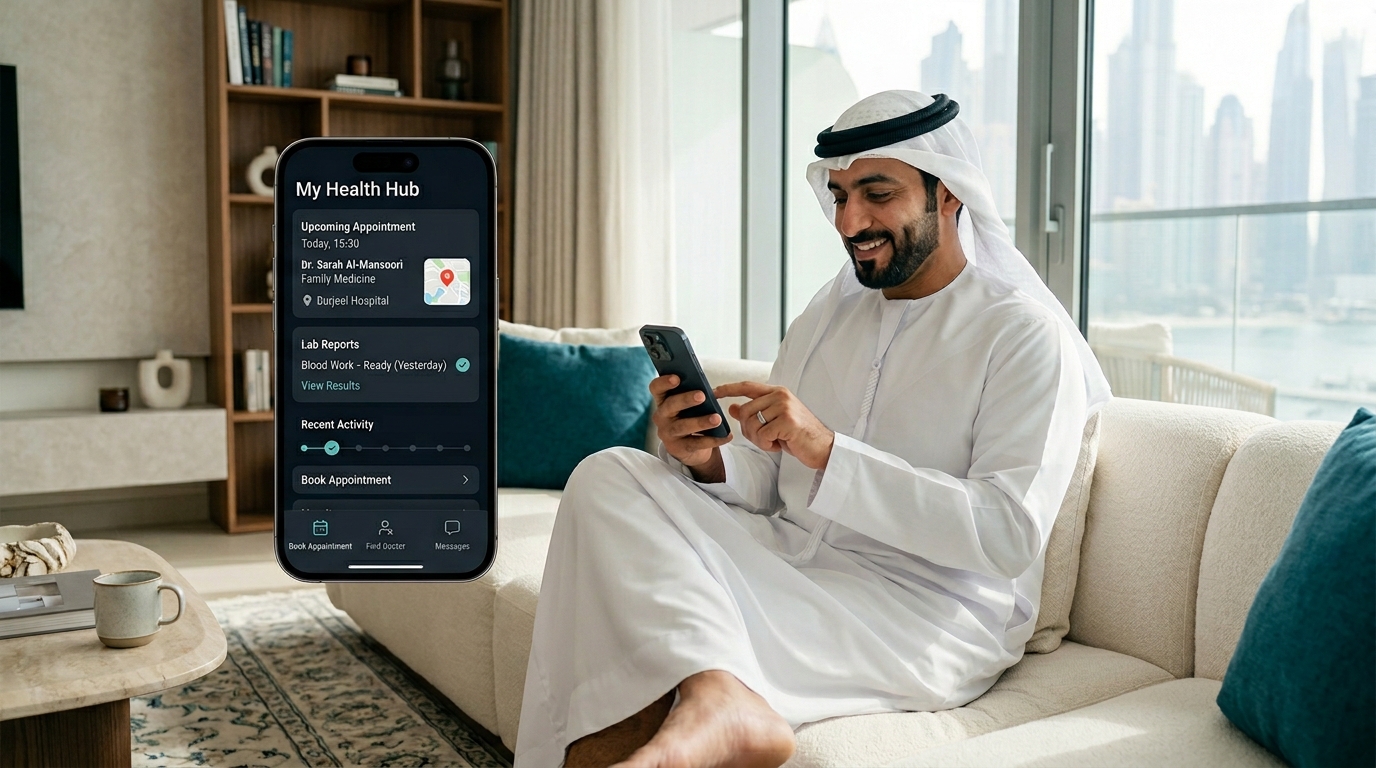
Three technology layers underpin the UAE’s telehealth infrastructure: artificial intelligence, electronic medical records (EMR), and mobile-first platforms.
Artificial Intelligence in Clinical Decision Support
AI is doing more than powering chatbots in UAE healthcare. Platforms are now using AI diagnostics to analyse patient symptoms with accuracy rates reaching approximately 90% in triage applications. Predictive analytics tools identify at-risk patients before their condition deteriorates, shifting the clinical model from treatment to prevention.
For clinics and corporate providers, AI-driven tools reduce administrative burden significantly. Appointment scheduling, patient triage, follow-up reminders, and claims processing can all be partially automated, freeing clinical staff to focus on care delivery.
EMR and National Interoperability
Electronic medical records form the compliance backbone of every credible telehealth platform in the UAE. National infrastructure such as Malaffi in Abu Dhabi and NABIDH in Dubai centralise patient records across providers, allowing any licensed clinician to access a verified patient history with patient consent.
This interoperability is not simply a technical convenience. It is a clinical safety mechanism. When a remote consultation involves a patient with a complex medication history or comorbidities, access to a centralised, accurate record can change the outcome of that consultation.
Mobile Apps and Patient Portals
For patients, the mobile interface is the primary touchpoint. A well-designed patient portal should allow for appointment booking, lab result access, prescription management, and real-time health tracking in a single session, without requiring the user to navigate multiple systems or call a clinic to confirm details.
The Care by Freit portal is built around this principle. Patients can find doctors, find clinics, track appointments, and manage lab reports from one centralised dashboard, accessible on any device.
A Practical Checklist: Is Your Telehealth Setup Ready?
Before your first virtual consultation in the UAE, confirm the following:
- [ ] Your platform or provider is licensed by DHA, DOH, or MOHAP.
- [ ] Your personal health records are updated and accessible for sharing.
- [ ] You have a stable internet connection and a device with a working camera and microphone.
- [ ] You understand how your e-prescription will be issued and how to redeem it.
- [ ] Your patient portal offers secure, encrypted access to your records.
- [ ] You know the emergency escalation process if your condition requires urgent in-person care.
The Future of Connected Care in the UAE
The trajectory of telehealth in the UAE points toward healthcare that is predictive, personalised, and ambient. The next phase of development includes several emerging areas:
Home-based monitoring at scale. RPM technologies will extend further into home health contexts, covering post-surgical recovery, maternal monitoring, and elderly care management. Chronic disease patients, who represent approximately 15% of the UAE population, are expected to see hospitalisation rates fall as continuous monitoring matures.
AI-driven early intervention. The integration of AI analytics with wearable data will allow clinicians to intervene before a patient’s condition requires emergency treatment. Abu Dhabi’s Malaffi RPM pilot uses AI dashboards to detect anomalies and trigger clinical alerts in real time.
Value-based care models. As telehealth matures, the UAE’s insurance and reimbursement frameworks are evolving to cover virtual care under value-based arrangements. This shifts the incentive structure from volume of visits to quality of outcomes, benefiting both patients and providers.
Digital health passports. A collaboration between MOHAP, Etisalat Health, and Oracle Cloud is consolidating wearable data into national health records, creating a portable health profile that travels with the patient across every healthcare interaction.
Frequently Asked Questions About Telehealth and Remote Care in the UAE
1. What is telehealth and how does it work in the UAE?
Telehealth refers to the delivery of healthcare services through digital technologies, including video consultations, electronic prescriptions, remote patient monitoring, and digital lab results. In the UAE, telehealth and remote care services operate under the regulatory oversight of DHA (Dubai), DOH (Abu Dhabi), and MOHAP (Northern Emirates). Licensed providers use encrypted platforms to conduct consultations, issue prescriptions, and share clinical data securely. Patients access these services through dedicated portals or apps such as Care by Freit.
2. Is telehealth legal and regulated in the UAE?
Yes. Telehealth is fully legal and extensively regulated in the UAE. The DHA published its Telehealth Services Standards (Version 4) in 2025, setting enforceable requirements for licensing, patient consent, clinical protocols, and data privacy. MOHAP has additionally introduced legislation requiring medical facilities to offer at least one form of remote health service. Patients should always verify that their platform and practitioner carry the relevant licence before proceeding with telehealth and remote care.
3. Can I receive prescriptions through a telehealth consultation in the UAE?
Yes. Licensed telehealth providers in the UAE can issue electronic prescriptions following a virtual consultation. E-prescriptions are recognised and regulated under UAE healthcare law, and digital platforms integrated with pharmacy networks allow patients to redeem them without visiting a physical clinic. The Care by Freit portal is designed to support this workflow, connecting patients with licensed doctors who can issue compliant e-prescriptions.
4. What conditions can be treated via telehealth in the UAE?
A wide range of conditions can be managed through telehealth and remote care, including general consultations, follow-up reviews, chronic disease management (diabetes, hypertension, respiratory conditions), mental health support, paediatric advice, and skin or minor injury assessments. Conditions requiring physical examination, emergency intervention, or diagnostic imaging typically require an in-person visit. Your care team will advise if an in-person referral is needed.
5. How does remote patient monitoring work?
Remote patient monitoring (RPM) uses wearable devices or biosensors to collect health data such as blood pressure, glucose levels, heart rate, and oxygen saturation. This data is transmitted in real time to a care provider’s platform. Clinicians can review the data between appointments, identify concerning trends early, and intervene before a condition worsens. Research published in Electronics (MDPI, 2025) confirms that RPM significantly improves patient outcomes across a range of chronic conditions, including reductions in hospitalisation and mortality.
6. Is my health data safe on UAE telehealth platforms?
UAE law requires that all patient health data be encrypted, stored on UAE-based servers, and handled in accordance with the UAE Personal Data Protection Law. DHA-licensed platforms undergo regular compliance audits. Reputable portals such as Care by Freit maintain strict cybersecurity standards and transparent privacy policies that patients can review before registering.
7. How do I find a doctor for an online consultation in the UAE?
You can find licensed doctors for virtual consultations directly through the Care by Freit portal. The platform allows you to browse available practitioners, view their specialisations, check real-time availability, and confirm appointments, all from a single interface. You can also find clinics that offer telehealth services alongside in-person care.
8. Does the UAE government support telehealth adoption?
Strongly. The UAE government’s support for telehealth spans regulatory frameworks, national infrastructure investment, and strategic vision alignment. The UAE Vision 2031 names healthcare innovation as a national priority. The DHA has licensed over 2,000 telehealth providers in Dubai alone, while MOHAP operates a nationwide “Doctor for Every Citizen” programme providing encrypted virtual care access around the clock. The federal government has committed to a USD 20 billion investment in digital health by 2025 as part of its broader digital transformation agenda.
9. What is the difference between NABIDH and Malaffi?
Both are national health information systems designed to centralise patient records in the UAE. NABIDH is the DHA’s health information exchange for Dubai, enabling licensed providers to access and contribute to a unified patient record. Malaffi serves the same function for Abu Dhabi, operated by the DOH. Both platforms promote interoperability and care continuity across the healthcare ecosystem. Telehealth providers operating in compliance with UAE regulations connect to these systems to ensure records are complete, accurate, and accessible.
10. Can expatriates in the UAE use telehealth services?
Yes. Telehealth in the UAE is available to all residents, including the expatriate community, which accounts for close to 90% of the country’s population. Most licensed platforms support Arabic and English interfaces, with some offering multilingual support for additional languages. The Care by Freit portal is designed for the UAE’s diverse patient population, with straightforward registration and access for residents across all emirates.
Take Control of Your Healthcare Today
The shift toward telehealth and remote care in the UAE is not slowing down. Whether you are managing a chronic condition, booking a routine check-up, or accessing specialist advice, connected care means you no longer have to fit your health around a clinic’s schedule.
Care by Freit brings together verified doctors, online appointment booking, digital lab reports, and a secure personal health dashboard in one UAE-built platform. Join patients across Dubai, Abu Dhabi, and Sharjah who are already managing their health smarter.
Get started on Care by Freit today
Disclaimer: The information provided in this article is for general educational purposes only and does not constitute medical advice. Always consult a licensed healthcare professional for diagnosis, treatment, or medical guidance specific to your condition. Care by Freit connects patients with licensed practitioners but does not provide medical diagnoses directly. In the event of a medical emergency, contact emergency services immediately.